
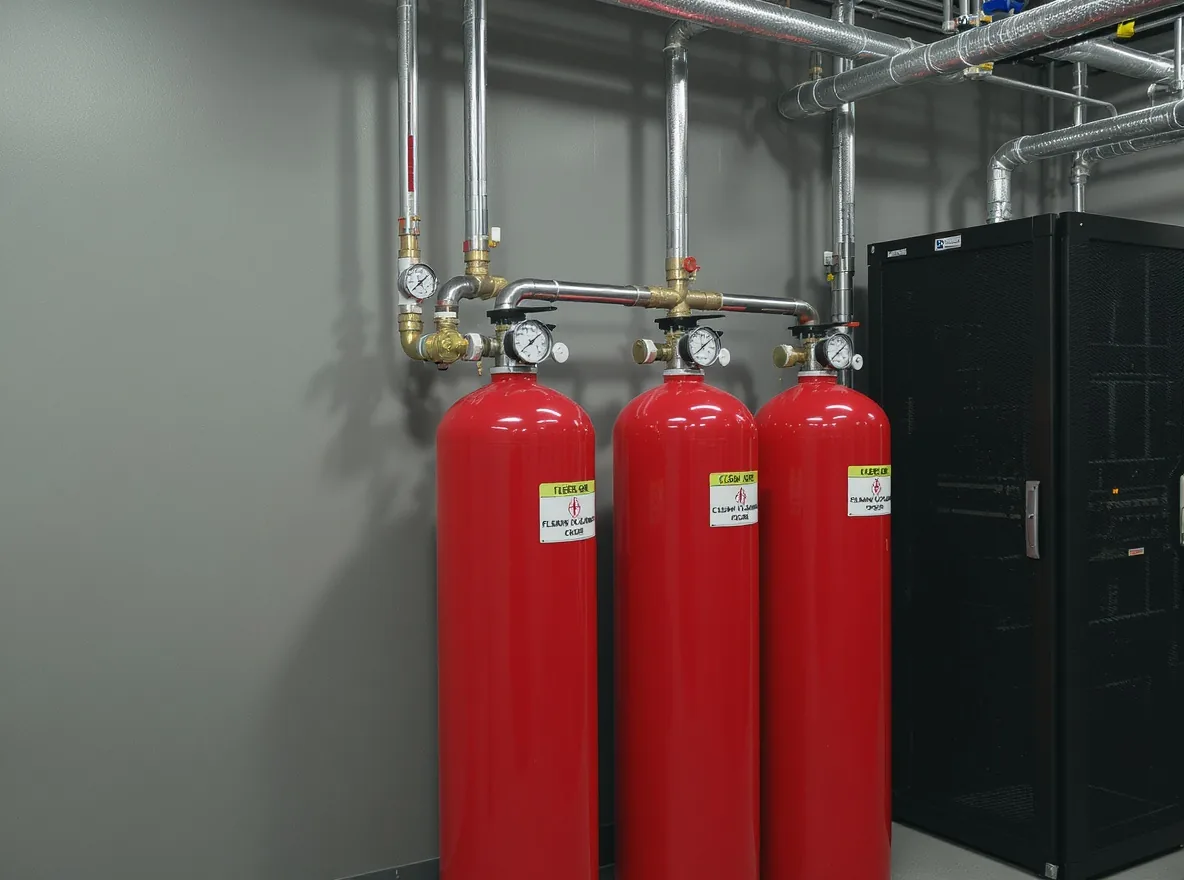
The cylinders are certified, the panel is commissioned, the paperwork is signed, and everyone in the building now believes the server room is protected. It might not be. A clean agent system empties into the room in about ten seconds and then has to keep that agent there long enough to finish the job. If the room leaks, the agent drains away and the fire re-establishes itself in a room whose cylinders are already empty. A door fan test is the only practical way to find out which of those two rooms you own, and it is the step most often left out of a South African suppression handover.
What room integrity testing is
Room integrity testing, also called a door fan test or an enclosure integrity test, measures how much air leaks out of a room protected by gas suppression. From that leakage figure it calculates how long the extinguishing agent will stay at its design concentration. It is a measurement of the room, not an inspection of the equipment.
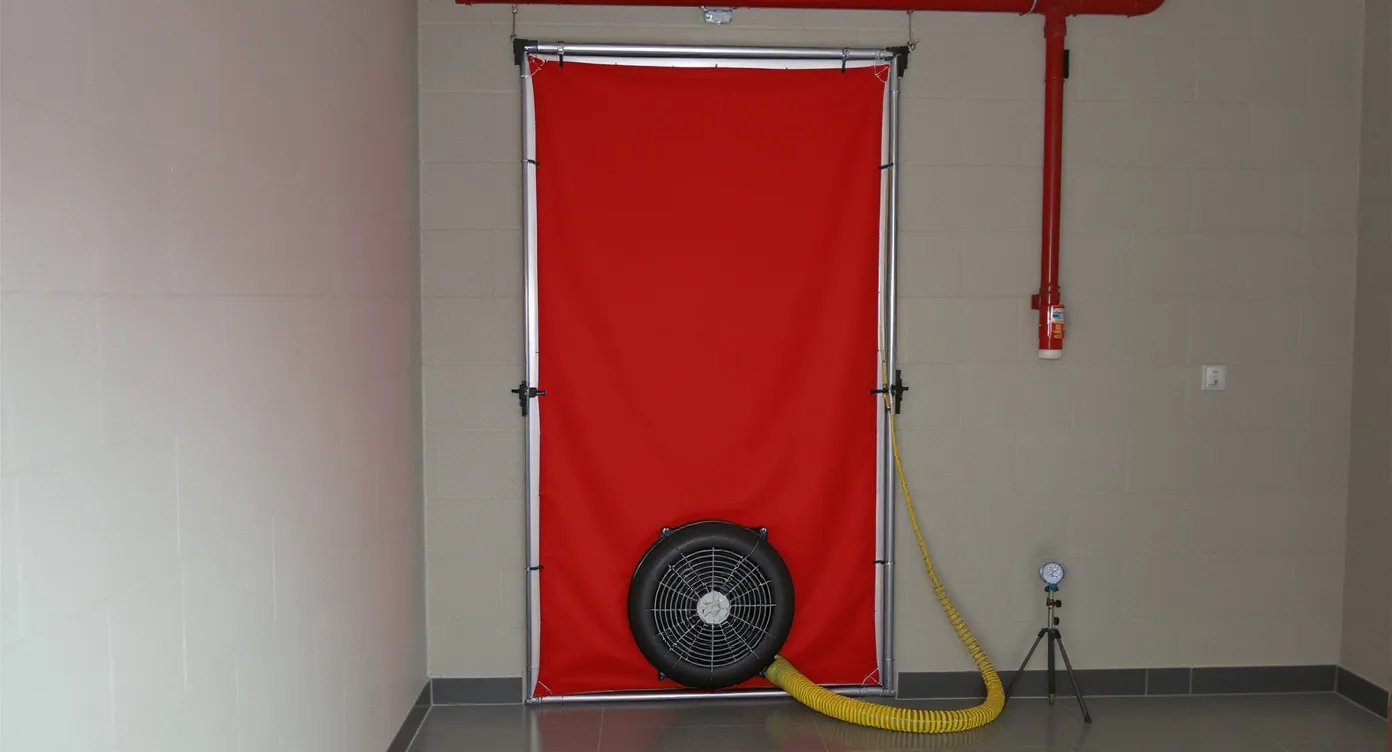
Room integrity testing is a quantitative test of the enclosure rather than of the suppression hardware inside it. C4 Fire & Security mounts a calibrated variable speed fan in the doorway of the protected room, pressurises and then depressurises the space, and records airflow against pressure difference. Those paired readings produce an equivalent leakage area, which is effectively the size of the single hole the room behaves as though it has. That leakage area is then converted into a predicted hold time: the number of minutes the agent will remain at design concentration above the height of the equipment being protected. SANS 14520, the South African standard for gaseous fire-extinguishing systems, is the design reference C4 works to on every installation across Cape Town and the Western Cape. A retention period of ten minutes is the figure most commonly specified. The test either predicts that your room achieves it or it does not, and that number belongs in the handover file.
The distinction matters, because the two get conflated constantly. A cylinder certificate proves the agent is in the bottle. A commissioning certificate proves the system discharges when told to. Neither says anything about whether the room can keep what it is given. Our commercial fire suppression overview covers where this sits in a Western Cape handover, and this article is the detail behind that one step.
Why rooms fail: hold time, not concentration
A suppression system can reach exactly the right design concentration and still fail. Concentration is won in the first ten seconds. Hold time is what happens over the following ten minutes. Most halocarbon clean agents are heavier than air, so they drain out through low level gaps while air enters higher up.
Picture the room a few seconds after discharge. The agent and air have mixed to design concentration and the mixture is denser than the air outside the room. That density difference is a pressure difference, and a pressure difference across a leak drives flow. Agent escapes through gaps near the floor and ordinary air is pulled in through gaps near the ceiling to replace it. What forms is a descending interface: a clean, breathable layer at the top that grows downwards, and a suppressing layer below it that shrinks. The system fails at the moment that interface falls below the top of the equipment you were trying to protect, which is usually well before the room is anywhere near empty of agent.
This is why the location of a leak matters as much as its size. A given hole low down in the wall costs you far more hold time than the same hole high up, because the low leak is where the agent actually leaves. A door fan test does not just total the leakage; it separates it into upper and lower leakage so the predicted hold time reflects the real geometry. Inert gas systems such as Inergen behave differently again, being closer to the density of air, but the principle is unchanged: the room, not the cylinder bank, decides the outcome.
How a door fan test is carried out
A calibrated fan is sealed into the doorway, the room is set to the state it would be in during a fire, and the fan pushes air in and then draws it out while airflow and pressure are logged. Software converts those readings into leakage area and a predicted hold time. The test takes a few hours, not a day.
- Set the room to its fire conditionAir handling shut down, dampers closed, doors shut on their seals. Testing a room in its everyday state measures a room that will not exist at the moment it matters.
- Record the room and the hazardVolume, the protected height, the agent and its design concentration, and the altitude of the site. Elevation changes the numbers, which matters between Cape Town and the higher Cape Winelands sites.
- Seal the calibrated fan into the doorwayThe fan sits in an adjustable panel that closes the opening, so the only air moving is air the instrument can measure.
- Pressurise, then depressuriseAirflow is logged against pressure difference in both directions. Running both is what allows the upper and lower leakage to be separated rather than lumped together.
- Calculate and reportThe readings give an equivalent leakage area, and from that a predicted hold time against the design requirement. The result is a pass or a fail with a number attached, not an opinion.
Four numbers on a door fan report
If the report you were handed does not contain these, it is not a room integrity test.
- ELAEquivalent leakage areaThe single hole the room behaves as if it has.Measured
- SplitUpper and lower leakageWhere the leaks sit, which drives the drain rate.Measured
- HoldPredicted retention timeMinutes at design concentration above the protected height.Calculated
- PeakDischarge pressureWhat the walls must survive in the first ten seconds.Calculated
A certificate that states only “pass” without a predicted hold time in minutes is not evidence of anything. Ask for the number.
Where rooms actually leak
Rooms almost never fail because of one dramatic hole. They fail on an accumulation of ordinary building details, most of them created after handover by trades who had no idea the room was a suppression enclosure. Cable penetrations are the most common single cause.
- Cable and pipe penetrationsEvery new circuit pulled through a wall is a new leak unless it is resealed. This is the leading cause of a room that passed at handover failing two years later.
- Raised floor and ceiling voidsA void that runs past the room boundary turns the whole plenum into part of your enclosure, and usually a very leaky part.
- Door seals and undercutsA door that no longer closes cleanly on its seal, or an undercut left for airflow, sits exactly where a heavier than air agent wants to escape.
- Dampers that do not closeA damper that is assumed to shut on alarm and does not is a large, high level opening that no visual inspection will reveal.
- Wall constructions that stop shortPartition walls built to the suspended ceiling rather than to the slab are extremely common and extremely leaky.
- Pressure relief ventsNecessary, but an oversized or wrongly specified vent will destroy hold time on its own. See the section below.
Where a room fails, C4 Fire and Security identifies the leakage paths, seals them and retests, rather than reaching for a bigger cylinder bank. Adding agent to compensate for a leaking room is expensive and it does not fix the descending interface. Sealing is almost always cheaper than the gas, which is worth knowing before you approve a quote. Our note on what suppression systems cost in South Africa sets out where the money actually goes.
Pressure relief venting, and why a bigger vent is not a safer vent
Discharging an agent into a sealed room spikes the pressure inside it, and that spike can damage walls, ceilings and doors. A pressure relief vent releases the spike. But the same vent is a permanent hole in the enclosure, so oversizing it trades a structural problem for a hold time problem.
This is the tension at the centre of every well designed suppression room. The vent has to be large enough to release the peak pressure of a discharge, which happens within the first few seconds, and small enough that it does not bleed the agent away over the following ten minutes. Those requirements pull in opposite directions, and the only way to resolve them is arithmetic based on the real room volume, agent and discharge rate. A vent sized by eye is a coin toss. The door fan test is where a wrongly sized vent is caught, because it shows up as leakage that no amount of sealing elsewhere will overcome.
When a door fan test is required
At commissioning, without exception, because an untested room has no evidence behind it. Then after any change to the enclosure, after any discharge, and on a recurring interval. C4 runs the retest as part of the annual service visit so it is not left to be remembered separately.
| Trigger | Why it matters | What C4 does |
|---|---|---|
| Commissioning | Establishes the baseline hold time. Without it there is no evidence the system will work when it discharges. | Test before handover; the predicted hold time goes into the handover file and the logbook. |
| Enclosure change | New cabling, a moved partition, a replaced door or new ductwork all change the leakage picture. | Retest the room, not just the affected wall, because leakage is a whole-room property. |
| After a discharge | The discharge itself can disturb seals, ceiling tiles and vents, and the room must be proven again before it is trusted. | Retest alongside cylinder refill and recharge, then re-issue the certificate of service. |
| Annually | Rooms drift. Leaks accumulate quietly through ordinary building work that nobody logs. | Run the test on the annual service visit and record the result against the previous year. |
The annual pattern matters more than it sounds. A room that passed at ten and a half minutes on handover and reads eight three years later has not suffered an event, it has simply had cables pulled through it. Only repeated measurement makes that visible, which is why C4 Fire and Security records the number, and not just the pass, in the logbook alongside the certificate of service.
Book a door fan room integrity test
C4 Fire and Security tests, seals and retests gas suppression enclosures across Cape Town, the Cape Winelands and the West Coast from its base in Simondium, and records the predicted hold time in your logbook. No obligation.
Room integrity testing, frequently asked questions
What is a door fan test?
A door fan test is a room integrity test carried out with a calibrated variable speed fan sealed into the doorway of a room protected by gas suppression. The fan pressurises and then depressurises the room while airflow and pressure difference are logged. Those readings give an equivalent leakage area, which is converted into a predicted hold time: how long the extinguishing agent will remain at design concentration above the protected equipment. The terms door fan test, room integrity test and enclosure integrity test all describe the same procedure.
How long must a gas suppression room hold the agent?
A retention period of ten minutes is the figure most commonly specified for clean agent systems, measured at design concentration above the height of the equipment being protected. The exact requirement for your room follows from the design, the agent selected and the hazard, so it should be stated explicitly in your handover documentation rather than assumed. What matters practically is that the door fan report gives a predicted hold time as a number in minutes, and that the number meets or exceeds the design requirement written into the system specification.
Why did my server room fail its room integrity test?
Almost always because of an accumulation of ordinary leaks rather than one obvious hole. The most common cause by a wide margin is cable and pipe penetrations that were never resealed after subsequent work. Close behind are raised floor and ceiling voids that continue past the room boundary, partition walls built to the suspended ceiling instead of to the slab, doors that no longer seat on their seals, dampers that do not close on alarm, and pressure relief vents that were oversized. C4 Fire and Security identifies the leakage paths, seals them and retests.
Can a failed room be fixed without adding more gas?
Usually, yes, and that is the right order to try things in. Sealing leakage paths is typically far cheaper than enlarging a cylinder bank, and it addresses the actual cause. Adding agent to compensate for a leaking enclosure does not stop the descending interface from falling, it raises the running cost of every future refill, and in occupied rooms it can push concentration towards levels that raise separate safety questions. C4 seals and retests first, and only revisits the system design if the enclosure genuinely cannot be brought up to standard.
How often should room integrity testing be repeated?
At commissioning, after any change to the enclosure, after any discharge, and then on a recurring interval. C4 Fire and Security runs the retest as part of the annual service visit, so it is not left as a separate item to be remembered, and records the predicted hold time against the previous year. That year on year comparison is what reveals slow degradation from ordinary building work, which is the way most rooms lose their integrity. Gas suppression servicing in South Africa also involves a five yearly cylinder hydrostatic test under SANS 14520.
Not sure your room has ever been tested?
Ask for the predicted hold time in minutes. If nobody can produce one, the room has never actually been proven. C4 will test it and tell you where it stands.
This article is general fire safety guidance, not a substitute for a site specific design, a commissioning test or professional engineering advice. SANS standards are referenced for context and are summarised from published secondary sources; always confirm the current published version of any standard, and its application to your premises, with a qualified professional.