Search for a fire risk assessment from South Africa and most of the first page answers a different country’s law. A GOV.UK checklist. London Fire Brigade guidance. A “Type 1 to Type 4” classification that comes from British housing legislation. None of it is the law here. The duty in South Africa sits in the Occupational Health and Safety Act, and a proper assessment does something those pages barely mention: it decides which category of fire detection system your building actually needs.
What a fire risk assessment is in South African law
A fire risk assessment is a structured inspection of your premises that identifies fire hazards, establishes who is at risk, and tests whether existing precautions are adequate. In South Africa it serves the Occupational Health and Safety Act, and its findings drive both your fire detection design and your insurer’s view of the building.
The clearest local statement of purpose comes from the Fire Protection Association of South Africa, which describes its workplace assessment as “specifically tailored to meet the intentions of the Occupational Health and Safety Act”. FPASA notes that a full assessment weighs “life and property risks” and includes “assigning a risk category to each assessment area”. That last phrase carries more weight than it appears to. The life-versus-property split is not a reporting convenience. It is the same division that runs through South Africa’s fire detection standard, and it is the reason two buildings of identical size can lawfully need very different systems. When C4 Fire & Security assesses a site anywhere in the Western Cape, separating those two risks is the first substantive judgement made, because everything downstream depends on it.
Note what this is not. It is not a certificate you buy, and it is not a form you file once. It is a judgement about your specific building, its occupants and its contents, recorded in a way that someone else can audit later.
Why UK guidance dominates the results, and where it stops applying
South African fire detection practice is genuinely derived from British practice, which is why UK pages rank so well here. SANS 10139 is based on the British standard BS 5839-1. But derivation is not jurisdiction. The UK’s Type 1 to Type 4 assessment classification has no standing in South African law.
This is worth stating plainly, because the confusion is understandable. Writing for SMART Security Solutions in December 2024, Nick Collins, chairman of the D&GS committee at SAQCC Fire, records that SANS 10139 “is based on the British Standard BS 5839-1, referenced in the Occupational Health and Safety Act, 1993 (Act No. 85 of 1993)”. So the technical lineage really does run back to Britain. What does not travel is the legal framework built on top of it. The UK’s Type 1 to Type 4 scheme describes how far an assessor may open up a block of flats, and it exists to serve British housing law. Applying it to a Cape Town warehouse is a category error. Collins also quotes the standard against itself: “Compliance with this document cannot confer immunity from legal obligations.” C4 Fire & Security treats that sentence as the whole point of an assessment.
How a fire risk assessment is carried out
Most competent assessors work through five stages: identify the hazards, identify who is at risk, evaluate and reduce the risk, record the findings and train staff, then review. The method is widely used and sound, but treat it as good practice rather than as a South African statutory checklist.
The five-stage method below is the one published by the United Kingdom’s Health and Safety Executive and reproduced by most assessors worldwide. It is included here because it is genuinely useful and because South Africa has no equivalent published checklist. It is a professional method, not a legal instrument.
- Identify the fire hazardsIgnition sources, fuel sources and oxygen sources, walked room by room rather than assumed from a floor plan.
- Identify the people at riskEveryone on the premises, with specific attention to lone workers, night shifts, visitors and anyone with reduced mobility.
- Evaluate, remove and reduceJudge how likely a fire is, then test whether detection, escape routes and first-response equipment are actually adequate.
- Record, plan and trainDocument the findings, set an action plan with owners and dates, and train the people who must act on it.
- ReviewReassess after any change to layout, occupancy, process or stock, and after any fire or near miss.
Step three is where an assessment earns its keep, and where a generalist and a fire engineer part company. Deciding that detection is “adequate” requires knowing what adequate means under the standard, which brings us to the part of the process that almost no page on the topic explains.
What the assessment decides: your SANS 10139 category
SANS 10139 sets out eight categories of fire detection and alarm system. Your risk assessment is what selects one. Category M is manual only. The L categories protect life, from complete coverage down to a single objective. The P categories protect property, either throughout the building or in defined parts.
The scope of the standard is a matter of public record. South Africa’s Government Gazette of 12 March 2021, in a Standards Act notice from the South African Bureau of Standards, records the title of SANS 10139 as the “Code of practice for design, installation, commissioning and maintenance of fire detection and alarm systems in non-domestic premises”. SAQCC Fire summarises the categories it contains as set out in the table below. Read them alongside FPASA’s point about assigning a risk category to each area, and the connection becomes obvious: the assessment produces the life and property risk picture, and SANS 10139 converts that picture into a system specification. Get the assessment wrong and you either overspend on detection you do not need, or you install an L5 system in a building that needed an L1.
| Category | What it protects | Coverage, per SANS 10139 as summarised by SAQCC Fire |
|---|---|---|
| M | People, by manual action | Manual call points only, with no automatic detection. Frequently built into an automatic system rather than used alone. |
| L1 | Life | Automatic detection throughout the premises. The most complete life safety category. |
| L2 to L4 | Life | Progressively reduced automatic coverage between L1 and L5. SANS 10139 defines the exact extent of each. |
| L5 | Life | Coverage designed to satisfy one specific fire safety objective. |
| P1 | Property | Automatic detection installed throughout all areas of the building. |
| P2 | Property | Automatic detection installed only in defined parts of the building. |
We have deliberately not invented definitions for L2, L3 and L4. SAQCC Fire’s published summary states that the L categories run from L1, meaning complete protection, down to L5, and the precise extent of the intermediate levels is set by the standard itself. Ask whoever designs your system to state your category in writing. If you want the detail on how these systems are specified and installed, our guide to commercial fire alarm installation under SANS 10139 covers it, and our fire detection systems guide compares the technologies.
The maintenance cadence almost nobody states correctly
Search results will tell you a fire detection system must be serviced every six months. Others will say annually. Both are fragments of the same clause. SANS 10139 sets four separate duties running on four different clocks, and a compliant building keeps all four.
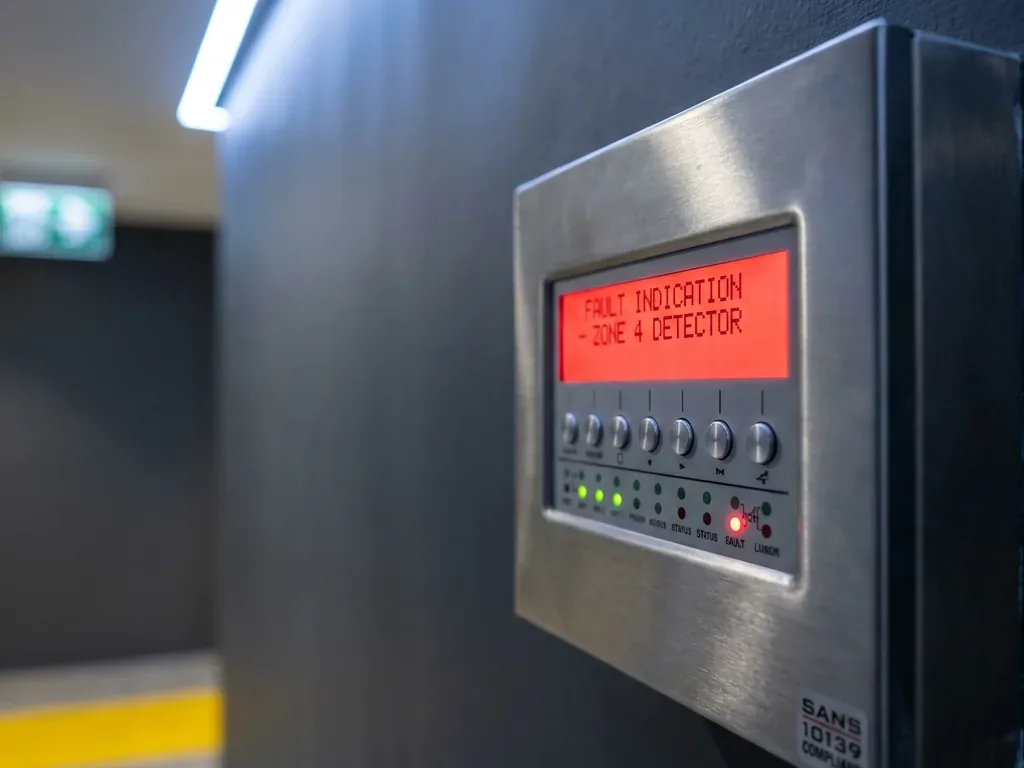
This is the single most misreported fact about fire detection in South Africa, and it matters because insurers read logbooks. According to SAQCC Fire’s published summary of the end user duties in SANS 10139, the control and indicating equipment should be checked visually at least every twenty four hours to confirm there are no fault conditions. The user should test the system weekly, normally by activating a manual call point. A competent person should inspect and service the system at least every six months. And a competent person should carry out full functional testing at least annually. Larger systems may need more frequent attention. C4 Fire & Security keeps all four intervals on a single schedule, because a building that services twice a year but never opens the logbook is still exposed.
Four duties, four clocks
The end user duties in SANS 10139, as summarised by SAQCC Fire.
- 24 hrsVisual checkConfirm the panel shows no fault condition.End user
- WeeklySystem testNormally by activating a manual call point.End user
- 6 monthsInspect and serviceAt a maximum. More often on larger systems.Competent person
- AnnuallyFull functional testAt a minimum, across the whole system.Competent person
Six monthly servicing and annual functional testing are two different duties. Doing one does not discharge the other.
- Keep the logbookSafe keeping of the logbook and system documentation is an explicit end user duty.
- Name one responsible personAppoint a single person to supervise all matters relating to the detection system.
- Train your peopleStaff need regular training in the end user functions of the panel, not just a handover.
- Watch the panel after hoursA fault or an alarm at 2am is only useful if someone is actually alerted.
Fire protection for the building fabric itself, including escape routes, sits under a separate standard, and we cover it in our SANS 10400-T compliance guide. Whether anyone is alerted when the panel activates is a different question again, addressed in our guide to round the clock fire panel monitoring. The assessment is what ties all three together into one defensible picture of your premises.
Book a free fire risk assessment
A C4 specialist will walk your site, separate the life risk from the property risk, and tell you in writing which SANS 10139 category your building calls for. No obligation.
Fire risk assessment in South Africa, frequently asked questions
What are L1, L2, L3 and L4 fire alarm systems?
They are life safety categories within SANS 10139. SAQCC Fire’s published summary states that Category L systems are intended primarily for the protection of life and are subdivided from L1 down to L5. L1 provides complete automatic detection throughout a premises. L5 is designed to satisfy one specific fire safety objective. L2, L3 and L4 sit between those two poles with progressively reduced coverage, and the standard itself defines the exact extent of each. Your fire risk assessment determines which category your building requires.
What is a type 3 fire risk assessment?
It is a United Kingdom classification, not a South African one. In Britain, fire risk assessments of residential blocks are graded Type 1 to Type 4 depending on whether the assessor inspects only the common parts or also the individual flats, and whether the inspection is destructive. That scheme serves British housing legislation and has no standing in South African law. Here the relevant framework is the Occupational Health and Safety Act, together with SANS 10139 for detection and SANS 10400-T for building fire protection.
How often must a fire detection system be serviced in South Africa?
There is no single interval, which is why the answer is so often reported wrongly. According to SAQCC Fire’s summary of the end user duties in SANS 10139, the panel should be checked visually at least every twenty four hours, the user should test the system weekly, a competent person should inspect and service it at least every six months, and a competent person should carry out full functional testing at least annually. Larger systems may require more frequent servicing.
Who is allowed to carry out a fire risk assessment?
A competent person. In practice that means somebody with demonstrable training and experience in fire safety, and for work on detection systems, registration with SAQCC Fire. Competence is not a formality here, because the assessment decides your detection category and therefore what gets installed. C4 Fire and Security holds SAQCC registration at Level 5, and our team brings more than thirty years of combined experience in fire detection, prevention and suppression across the Western Cape.
Is a fire risk assessment a legal requirement in South Africa?
The Occupational Health and Safety Act places a general duty on employers to provide a working environment that is safe and without risk to health, and a fire risk assessment is the accepted way to discharge and evidence that duty. SANS 10139 is referenced in the Act. Note the standard’s own caution, quoted by SAQCC Fire: compliance with the document cannot confer immunity from legal obligations. Your insurer and your local authority will both expect to see an assessment.
Not sure which category your building needs?
That is exactly what an assessment answers. We will separate the life risk from the property risk and put your SANS 10139 category in writing.
This article is general fire safety guidance, not a substitute for a site specific fire risk assessment or professional engineering advice. SANS standards are referenced for context and are summarised from published secondary sources; always confirm the current published version of any standard, and its application to your premises, with a qualified professional.