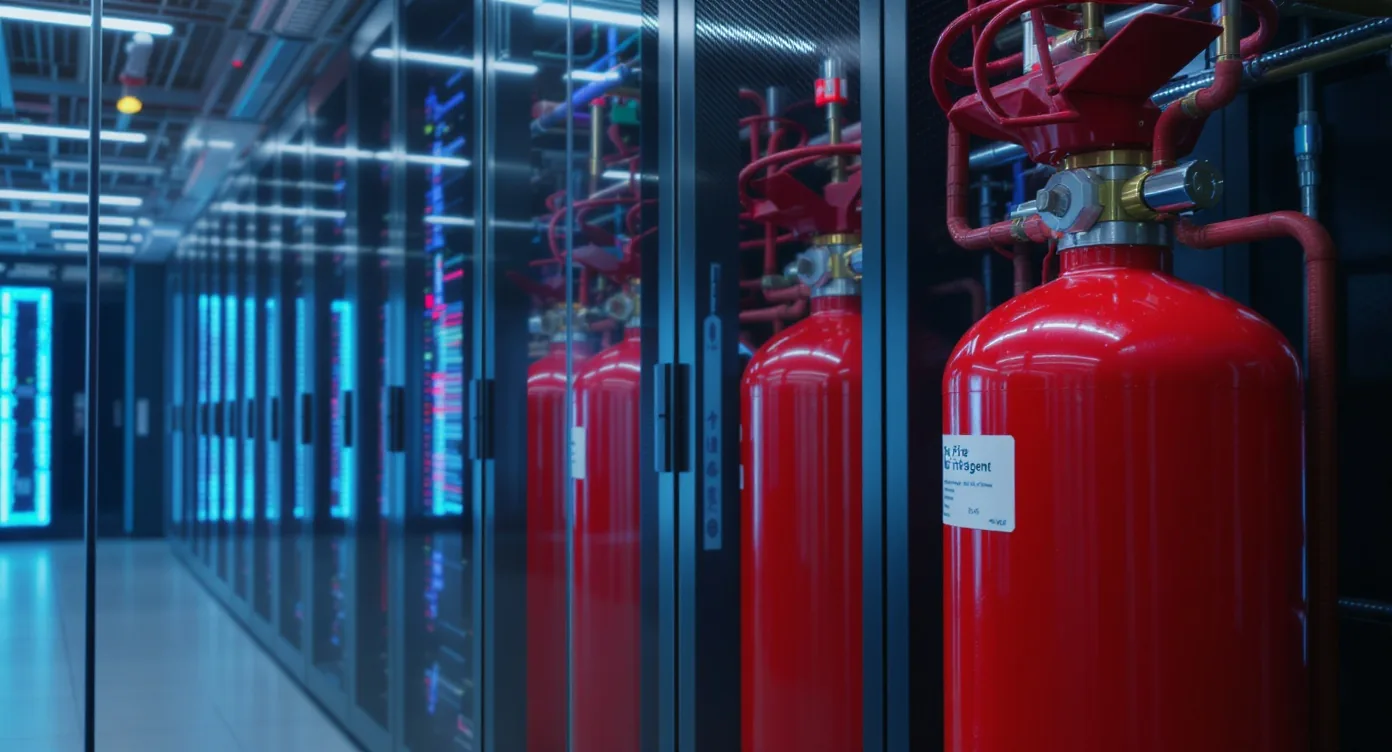
A fire in a server room is rarely about flames. It is about smoke, heat and the split-second decision of what puts the fire out. If your answer is a sprinkler, you have already lost the equipment, because water and live electronics do not survive each other. A gas suppression system is engineered for exactly this problem: it floods the room with a clean agent that stops the fire in seconds and leaves your hardware untouched. This is how it works, which agent suits which space, and what a compliant installation involves.
Why server rooms and data centres need gas suppression, not water
Water suppression stops the fire but destroys the servers, and the downtime often costs more than the fire. A gas suppression system uses a clean, electrically non-conductive agent that extinguishes the fire without residue, so your equipment survives and your business keeps running. For critical rooms, that difference is the whole point.
In a data centre, the fire is only half the threat; the response is the other half. A sprinkler head over a live server rack means water damage, corrosion and a total rebuild, and the real cost is the outage that follows. The Uptime Institute’s 2024 outage analysis found that 54% of significant data-centre outages cost operators more than 100,000 US dollars, and one in five topped 1 million. A clean-agent gas suppression system avoids that outcome entirely: on detection, it releases an inert or chemical agent that floods the protected room and smothers the fire in seconds, leaving no water, no powder and no residue on the electronics. C4 Fire & Security designs and installs these systems for server rooms, data centres and control rooms across the Western Cape, because for a business that runs on uptime, keeping the hardware alive is the point of putting the fire out. See the full service on our gas suppression page.
How a gas suppression system works
Detection triggers the system, a control panel counts down to allow evacuation, and stored agent is released through pipework and nozzles to flood the room to a precise concentration. For chemical clean agents this happens in ten seconds or less, and the concentration is then held long enough to stop re-ignition.
A gas suppression system is a sequence built to be both fast and fail-safe. Fire is confirmed by detection, usually two independent detectors on a coincidence arrangement so a single faulty signal cannot discharge the system by accident. The suppression panel then runs a short countdown, giving anyone inside time to leave, before releasing the agent stored under pressure in cylinders. Through fixed pipework and nozzles the agent floods the entire volume of the room, reaching its design concentration in ten seconds or less for chemical clean agents such as FM-200 or Novec 1230. That concentration is then held for a period, typically around ten minutes under the room-integrity rules of SANS 14520, long enough to ensure the fire is truly out. Detection and suppression are a single engineered chain, which is why C4 Fire & Security integrates the two, often pairing gas suppression with aspirating smoke detection for the earliest possible trigger; our fire detection systems guide explains that detection side in full.
Clean agents compared: FM-200, Novec 1230, Inergen and CO2
There is no single best agent, only the right one for the room and the people in it. FM-200 and Novec 1230 are chemical clean agents that work fast and are safe in occupied spaces. Inergen is a natural inert-gas blend. CO2 is powerful but only for spaces that are normally unoccupied, because it displaces oxygen.
The agent choice balances three things: safety for people, impact on the environment, and the nature of the protected space. C4 Fire & Security works with the four agents most used in South African facilities. FM-200 is proven and compact but has a high global warming potential of around 3,350 and sits inside the global phase-down of HFC gases. Novec 1230 is the modern alternative, with a global warming potential of just 1 and an atmospheric lifetime of about five days, as reported by manufacturers and clean-agent bodies under NFPA 2001. Inergen is a blend of nitrogen, argon and carbon dioxide that suppresses fire by lowering oxygen to a level that no longer supports combustion while remaining breathable. CO2 extinguishes effectively but is an asphyxiant, so it is reserved for spaces that are normally unoccupied. The table sets the four side by side.
| Agent | How it stops fire | Safe with people | Environment | Best-fit space |
|---|---|---|---|---|
| FM-200 | Chemical, absorbs heat | Yes, at design concentration | High GWP (~3,350), HFC phase-down | Compact server and equipment rooms |
| Novec 1230 | Chemical, absorbs heat | Yes, at design concentration | Very low GWP (~1), ~5-day life | Data centres, future-proofed sites |
| Inergen | Lowers oxygen below combustion | Yes, remains breathable | Natural gases, zero GWP | Larger data halls, control rooms |
| CO2 | Displaces oxygen | No, unoccupied only | Effective, but an asphyxiant | Switchgear, plant, unmanned spaces |
Protecting a server room, data hall or control room?
Book a free fire risk assessment. A C4 fire engineer will assess your space, recommend the right clean agent, and design a system to SANS 14520. No obligation, no jargon.
Which spaces need gas suppression
Gas suppression is for spaces where water would do as much damage as the fire, and where downtime is expensive. That means server rooms, data centres, control and electrical rooms, archives and any space full of high-value, hard-to-replace equipment or records.
If a room holds equipment or records you cannot afford to lose, and cannot afford to soak, it is a candidate for gas suppression. Across the Western Cape, C4 Fire & Security protects exactly these environments, from data centres in Cape Town to control rooms and archives on Cape Winelands wine estates. The common thread is value and continuity: the contents are critical, and an outage is costly. The spaces below are the ones most often protected with a clean-agent system.
- Server roomsLive racks where water means a full rebuild.
- Data centresData halls where uptime is the whole business.
- Control & electrical roomsSwitchgear and panels that run the site.
- Archives & recordsIrreplaceable documents and cold-stored media.
- LaboratoriesSensitive instruments and stored samples.
- Wine-estate cellarsProduction, bottling lines and estate switchrooms.
SANS 14520 and ISO 14520: designing a compliant, safe system
A gas suppression system is only as good as its design and its enclosure. SANS 14520, aligned with ISO 14520, sets the concentration, discharge and hold-time rules, and requires a room-integrity test to prove the room actually holds the agent. Skip that testing and the agent leaks away before the fire is out.
The agent only works if the room keeps it in. That is why SANS 14520, the South African adoption of ISO 14520 for gaseous fire-extinguishing systems, governs not just the agent quantity but the sealing of the enclosure. A correctly designed system reaches a proven design concentration, then holds it, and the way that hold time is verified is a room-integrity or door-fan test, which measures how well the room retains the agent without discharging a single cylinder. A ten-minute hold time is the standard benchmark, and the integrity test is repeated annually. C4 Fire & Security designs every system to SANS 14520 and carries out the integrity testing, so a system that looks finished on paper is proven to work in practice. The checklist below covers what a compliant design must address.
- Correct design concentrationAgent quantity calculated for the exact room volume.
- Fast dischargeChemical agents flood the room in ten seconds or less.
- Verified hold timeRoom-integrity door-fan test proves the room holds the agent.
- Over-pressure ventingRelief so the discharge does not damage the structure.
- Interlocks & signageSafe abort, warning signs and controlled entry.
- Annual integrity retestRe-tested every year, or after any change to the room.
What a C4 gas suppression project involves
A proper installation runs from risk assessment to annual maintenance. C4 assesses the space, calculates the agent, installs the detection, cylinders and pipework, then commissions the system with a room-integrity test and certifies it. After handover, an annual service and integrity retest keep it compliant.
Getting gas suppression right is an engineering process, not a product purchase. C4 Fire & Security brings more than 30 years of combined team experience to each project, working from a free fire risk assessment through to the certificate and the ongoing maintenance that keeps the system valid. The stages below show what a complete C4 project looks like, from the first site visit in Simondium, Paarl or Cape Town to the annual integrity retest that keeps your insurer satisfied.
- Risk assessment and designWe assess the room, the risk and the value inside, then design the system.
- Agent selection and SANS 14520 calculationThe right agent and the exact concentration for your room volume.
- InstallationDetection, panel, cylinders, pipework and nozzles installed to standard.
- Commissioning and integrity testFull cause-and-effect proven, plus a room-integrity door-fan test.
- Certification and handoverCompliance certificate and documentation for your records and insurer.
- Annual service and retestYearly maintenance and integrity retest to keep the system valid.
Your servers are worth more than a sprinkler head
Talk to a C4 fire engineer about clean-agent gas suppression for your server room or data centre, designed and certified to SANS 14520.
Gas suppression systems, frequently asked questions
Is gas suppression safe for people in the room?
Yes, for the right agent. Chemical clean agents such as FM-200 and Novec 1230, and inert blends like Inergen, are designed to suppress fire at concentrations that are safe for people, and the system runs a countdown so anyone inside can leave before discharge. CO2 is the exception: it works by displacing oxygen and is used only in spaces that are normally unoccupied. C4 Fire & Security selects the agent to match whether the room is occupied, and fits safe-abort controls and clear signage.
Will gas suppression damage my servers or equipment?
No. That is the whole reason clean-agent gas suppression exists. The agents are electrically non-conductive and leave no water, powder or residue, so equipment that survives the fire keeps running afterwards. This is the key advantage over sprinklers in a server room or data centre, where water damage and the downtime that follows often cost far more than the fire itself. C4 designs gas suppression specifically to protect the hardware, not just the building.
How much does a gas suppression system cost?
Cost depends on the size of the room, the agent chosen, and how much sealing and detection the space needs, so there is no single figure. A small server room protected with Novec 1230 is very different from a large data hall on Inergen. Rather than quote blind, C4 Fire & Security starts with a free fire risk assessment and a SANS 14520 design, then gives you a costed proposal so you know exactly what the investment covers.
FM-200 or Novec 1230, which should I choose?
Both extinguish quickly and are safe in occupied rooms, so the deciding factor is usually the future. FM-200 has a high global warming potential of around 3,350 and sits within the global HFC phase-down, which can affect long-term supply and cost. Novec 1230 has a global warming potential of just 1 and a short atmospheric lifetime, which makes it the more future-proof choice for new installations. C4 Fire & Security will recommend the agent that best fits your room, budget and long-term plans.
How often must a gas suppression system be serviced?
A gas suppression system should be serviced annually, and the room-integrity test that proves the enclosure still holds the agent is also repeated each year, or sooner if the room is altered. Cylinders, detection and the control panel are all checked as part of the service. Keeping this schedule is essential for both safety and your insurance position. C4 Fire & Security handles annual servicing and integrity retesting for gas suppression systems across the Western Cape.
Get a gas suppression system designed for your space
From server rooms to wine-estate cellars, C4 Fire & Security designs, installs and certifies clean-agent gas suppression across the Western Cape.
This article is general fire-safety guidance, not a substitute for a site-specific fire risk assessment or professional engineering advice. SANS and ISO standards are referenced for context; always confirm the current published version and its application to your premises with a qualified professional. Agent properties are drawn from published manufacturer and standards data. Figures are indicative.