
Make Sure Your Room Can Hold the Agent
Gas suppression only works if the room is sealed properly. Room integrity testing (door fan test) verifies that your protected space can retain the extinguishing agent at the required concentration for the required duration. C4 Fire & Security provides certified room integrity testing across the Western Cape.
Commissioning Requirement
Room integrity testing is mandatory before commissioning any gas suppression system. Without it, you cannot certify the system.
Identifies Leaks
The door fan test pressurises the room to identify air leaks that would allow the suppression agent to escape too quickly.
Annual Verification
Structural changes, new cable penetrations and door seal degradation can compromise room integrity over time. Annual testing catches these issues.
Room Integrity Testing for Gas Suppression
C4 Fire & Security performs room integrity testing (door fan tests) for all types of gaseous fire suppression systems including FM200, Novec 1230, Inergen, CO2 and clean agent systems. The test uses calibrated fan equipment to pressurise and depressurise the room, measuring the Equivalent Leakage Area (ELA) and calculating the agent retention time to verify it meets the required hold time.
Book a Door Fan Test- Calibrated door fan test equipment
- Equivalent Leakage Area (ELA) measurement
- Agent retention time calculation
- Leak identification and remediation guidance
- Pre-commission and annual verification
- Certified test reports for compliance files
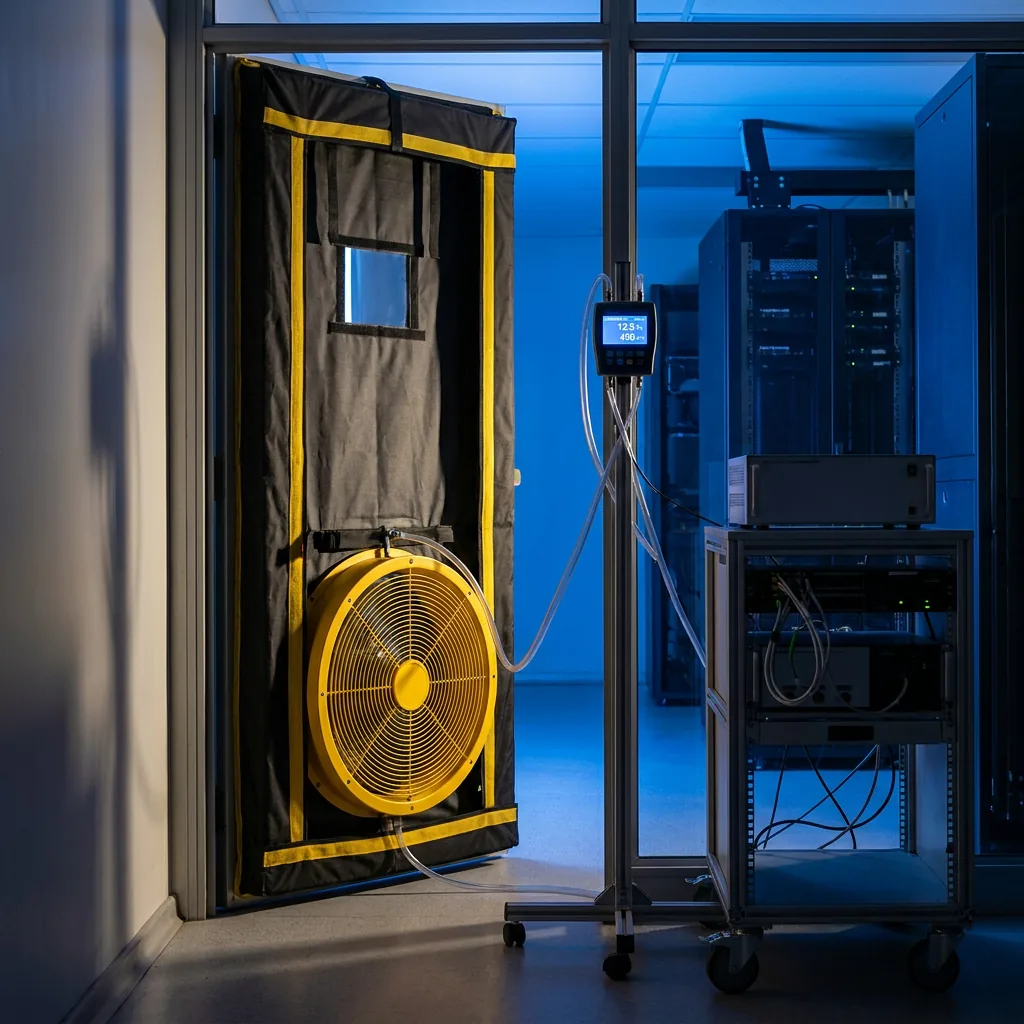
What a door fan integrity test rig looks like
A calibrated fan, pressure tubing and a digital manometer measure the room's leakage area and predict hold time against the agent's design concentration.
-
Door fan rig set up in a server room
How It Works
Schedule the Test
Book a convenient time. The room must be in its normal operational state for accurate results.
Install Test Equipment
Our technician installs the calibrated door fan in the primary entrance.
Pressurise & Measure
We pressurise and depressurise the room to calculate ELA and predicted agent retention time.
Report & Remediate
You receive a certified report. If the room fails, we identify leak locations and recommend remediation.
Tap a card for the door fan test detail
A clean-agent system that fires into a leaky room is wasted money. Tap any card for the detail.
-
Door fan test method
A calibrated fan blows into the room and measures leakage at design concentration.
- Calibrated door fan with pressure manometers
- Pressurises and depressurises the room
- Leakage area calculated from flow at known pressure
- Predicted hold time calculated for the agent
- Pass / fail issued against the 10-minute hold target
-
Hold time calculation
Minimum hold time at design concentration is 10 minutes (SANS 14520).
- Agent concentration over time predicted from leak rate
- Room volume and design concentration as inputs
- Hold time graphed for the first 10 minutes
- Pass if concentration stays above the design minimum for 10 min
- Re-test required after any building work
-
Common failures
Five things that cause rooms to fail integrity testing.
- Cable penetrations not sealed
- Floor void open to adjoining spaces
- Ceiling void open to plenum
- Doors warped or seals worn
- HVAC dampers not closing on signal
-
Remediation
Most failures are sealed and re-tested on the same day.
- Fire-rated foam and intumescent putty for penetrations
- Floor and ceiling void barrier check
- Door seal replacement
- Damper actuator test and re-set
- Re-test after remediation
-
Annual re-test
Room integrity must be re-tested every 12 months under SANS 14520.
- Scheduled with the system service
- Required by most commercial insurers
- Required by municipal occupancy certificates
- Certificate issued and filed in logbook
- Triggers remediation quote if pass is not achieved
Get Your Free Quote
Simondium, Western Cape, 7670
Office: Mon - Fri, 8:00 - 17:00
24/7 Emergency Callouts
Frequently Asked Questions
Room integrity testing is mandatory before initial commissioning of any gas suppression system. After that, annual testing is recommended and often required by insurers. Additional testing is needed after any structural modifications, new cable penetrations or door/damper changes.
We identify the leak locations during the test process. Common culprits are cable penetrations, door seals, suspended ceiling gaps and HVAC dampers. We provide specific remediation guidance and can retest after repairs are completed.
Yes. The test is non-destructive and does not affect equipment or operations. The room should be in its normal state (doors closed, HVAC in normal mode) for the most accurate results.
Verify Your Room Before You Need It
Book a room integrity test today. Do not discover your room leaks during a real fire emergency.