
Fire Risk Assessment: Complete Step-by-Step Guide for Facilities
Comprehensive fire risk assessment guide for facilities covering hazard identification, team assembly, system evaluation and compliance requirements.
FIRE PREVENTIONRISK MANAGEMENT
C4 Fire & Security
11/19/20255 min read
Why Fire Risk Assessments Are Critical for Facility Safety
Facility managers across South Africa face an alarming reality: workplace fires cause millions of rand in damages annually while threatening employee safety. The difference between facilities that prevent fires and those that suffer catastrophic losses often comes down to one critical factor: systematic fire risk assessment conducted by qualified assessment teams.
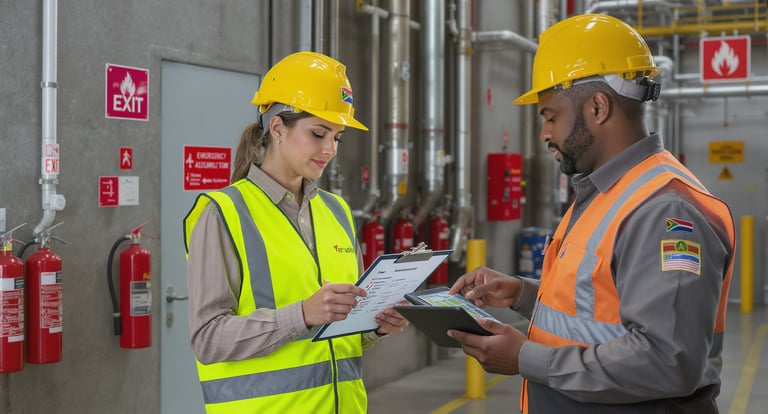
Unlike basic safety inspections conducted by individual staff members, comprehensive fire risk assessments require a multi-disciplinary approach. Professional fire protection experts work alongside facility managers to identify fire hazards, evaluate ignition sources, and assess workplace fire risks using proven methodologies.
This complete guide provides facility management teams with a systematic approach to conducting thorough assessments. You'll learn how to assemble the right assessment team, document fire hazards accurately, and develop risk mitigation strategies that protect both people and property.
Understanding Your Legal Obligations
South African facilities must comply with the Occupational Health and Safety Act, which mandates regular workplace fire safety assessments. Facility managers are legally required to identify fire hazards and implement appropriate fire protection systems. Non-compliance can result in hefty fines and operational shutdowns.
The Cost of Fire Incidents in South African Facilities
Fire incidents impact more than just immediate property damage. Business interruption, employee injuries, regulatory penalties, and insurance premium increases create long-term financial consequences that proper fire risk assessment helps prevent.
Step 1: Assemble Your Multi-Disciplinary Fire Risk Assessment Team
Effective fire risk assessment requires diverse expertise that no single individual possesses. Successful assessments depend on collaborative teams that combine operational knowledge with technical fire safety expertise. This team-based approach ensures comprehensive hazard identification and practical mitigation strategies.
Your assessment team should include both internal stakeholders and external fire protection experts. Internal team members understand daily operations, while external consultants provide technical expertise and regulatory knowledge. This combination creates assessment reports that are both thorough and implementable.
Professional fire assessment teams typically achieve more accurate results than individual assessments. The collaborative approach catches hazards that single-person evaluations often miss, particularly dynamic workplace fire risks that vary throughout operational cycles.
Essential Team Member Roles
1. Assessment Team Leader: Coordinates activities and ensures compliance with assessment protocols
2. Facility Operations Representative: Provides operational context and access to all facility areas
3. Maintenance Personnel: Offers technical insights into building systems and equipment conditions
4. Fire Protection Expert: Contributes specialized knowledge of fire safety equipment and emergency systems
5. Safety Manager: Ensures alignment with existing workplace safety programs
External Expert Considerations
Fire protection experts bring specialized knowledge of current fire safety regulations and advanced risk assessment methodologies. Consider engaging professional consultants for complex facilities, high-risk operations, or when internal expertise gaps exist.
Team Coordination Best Practices
Establish clear communication protocols and documentation responsibilities before beginning assessments. Schedule regular team meetings to discuss findings and coordinate mitigation efforts. Ensure all team members understand their specific roles and reporting requirements.
Step 2: Identify and Document Fire Hazards Throughout Your Facility
Systematic hazard identification forms the foundation of effective fire risk assessment. This process requires methodical examination of both static building conditions and dynamic operational hazards that change throughout workdays. Assessment teams must document all potential ignition sources while considering how operational patterns affect fire risk levels.
Successful hazard identification goes beyond obvious risks like electrical panels or chemical storage. Dynamic operational hazards, such as temporary equipment installations or seasonal operational changes, often create the highest workplace fire risks. These changing conditions require ongoing monitoring and documentation updates.
Fire hazards typically fall into three categories: ignition sources, fuel sources, and oxidizing agents. Assessment teams must examine how these elements interact within specific operational contexts. Understanding these relationships helps facility managers develop targeted fire risk mitigation strategies.
Common Ignition Sources by Facility Type
Fuel and Oxygen Source Assessment
Document all combustible materials including paper products, chemicals, textiles, and packaging materials. Assess how these materials are stored, handled, and disposed of during normal operations. Consider how ventilation systems might contribute to fire spread by providing oxygen sources.
Dynamic Operational Hazards
Identify risks that change based on operational schedules, seasonal activities, or temporary projects. Hot work operations, equipment maintenance, and construction activities create temporary fire hazards requiring special attention and documentation.
Step 3: Evaluate Current Fire Protection Systems and Equipment
Comprehensive infrastructure review ensures all fire protection systems meet current SANS standards and operational requirements. This evaluation covers detection systems, suppression equipment, and emergency systems that protect facilities during fire emergencies. Assessment teams must verify both system functionality and regulatory compliance.
Fire safety equipment assessment requires technical expertise to evaluate complex systems properly. Professional fire protection experts can identify equipment deficiencies that facility managers might overlook. This technical evaluation ensures compliance records accurately reflect actual system capabilities.
Current fire protection systems must integrate effectively with emergency procedures and evacuation routes. Assessment teams should evaluate how detection systems communicate with emergency systems and whether suppression systems provide adequate coverage for identified fire hazards.
Fire Detection and Alarm Systems
Smoke detector placement and coverage areas
Heat detection system functionality
Manual alarm station accessibility
Central monitoring system integration
Emergency communication system reliability
Suppression System Assessment
Sprinkler system coverage and water pressure adequacy
Special suppression systems for high-risk areas
Portable fire extinguisher placement and maintenance
Emergency shut-off system functionality
System inspection and maintenance records
Emergency Equipment Inspection
Emergency lighting system operation and backup power
Exit sign visibility and illumination
Emergency communication systems
Fire department connection accessibility
Emergency equipment storage and accessibility
Step 4: Assess Evacuation Routes and Emergency Procedures
Evacuation route analysis requires careful evaluation of egress capacity, accessibility compliance, and emergency communication effectiveness. Facility managers must ensure fire exits provide adequate capacity for peak occupancy while remaining accessible to all building users. This assessment considers both normal operations and emergency conditions.
Emergency procedures must integrate with physical evacuation infrastructure to ensure coordinated emergency response. Assessment teams evaluate how emergency communication systems support orderly evacuations while considering various emergency scenarios. Effective procedures account for different types of fire emergencies and occupant needs.
Evacuation planning requires understanding occupancy patterns throughout different operational periods. Peak occupancy calculations must consider visitors, contractors, and shift workers who may be unfamiliar with evacuation routes. Assessment documentation should reflect worst-case occupancy scenarios.
Exit Route Analysis
Primary and secondary evacuation routes must remain unobstructed and clearly marked throughout all operational periods. Evaluate exit route capacity during peak occupancy periods and consider how emergency conditions might affect evacuation flow. Document any accessibility barriers that could impede emergency egress.
Capacity and Flow Calculations
Calculate egress capacity based on occupancy loads and exit widths according to SANS building regulations. Consider movement speeds for different occupant types and how emergency conditions affect evacuation timing. Document capacity limitations and recommend improvements where necessary.
Emergency Communication Systems
Assess public address system coverage and backup power capabilities. Evaluate visual alarm systems for hearing-impaired occupants and emergency communication protocols for different areas. Ensure communication systems can effectively coordinate evacuations across entire facilities.
Step 5: Analyze Risk Levels and Prioritize Mitigation Measures
Risk analysis transforms hazard identification into actionable mitigation priorities using quantitative scoring methodologies. This systematic approach helps facility managers allocate limited resources to address the highest-priority workplace fire risks. Professional fire protection experts can provide technical input for accurate risk scoring.
Effective risk assessment combines probability estimates with potential impact severity to create comprehensive risk scores. This approach ensures hazard prioritization reflects both likelihood and consequences of fire incidents. Assessment teams should document their risk scoring rationale for future reference and compliance records.
Risk mitigation planning requires balancing immediate safety needs with operational constraints and budget limitations. Fire risk mitigation strategies should address high-priority risks first while considering implementation complexity and resource requirements. This prioritization ensures maximum safety improvements within available resources.
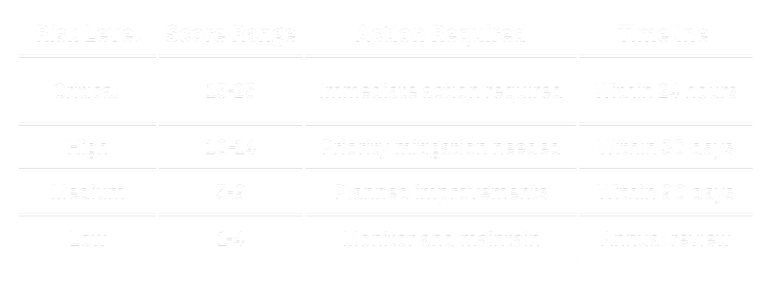
Risk Scoring Methodology
Impact vs Probability Assessment
Evaluate potential fire impact considering property damage, business interruption, life safety, and legal or compliance consequences. Combine this with probability factors such as how often ignition sources are present, the condition of equipment, and the quality of housekeeping.
Score impact and probability for each hazard, then use these scores to place risks in your matrix (Critical, High, Medium, Low) and set clear priorities. A simple, consistent scoring method turns your fire risk assessment into a practical action plan that you can justify to management, insurers, and regulators.




Safety
Committed to protecting lives and property.
Contact
+27 82 055 6337
+27 21 863 0040
sales@c4fire.co.za
© 2025. All rights reserved.
Website Designed & Maintained By KM-Digital Solutions